Can’t Walk 18 Holes? Ways to Keep Playing Golf
You may still feel perfectly comfortable hitting balls on the range or playing the first few holes, only to find that the walk starts taking over from the golf later in the round. If you can’t walk 18 holes comfortably, it is worth looking at what could make the day more manageable.
In this guide, we will go through the practical options, from changing the type of round you play to using a personal golf buggy.
You do not have to give up 18-hole golf
Walking a full course is a substantial part of the day. The R&A says most players walk between four and five miles during a regular 18-hole round. That does not include every detour between greens and tees or the extra ground covered looking for a ball.
It is therefore quite possible to enjoy swinging a club but struggle with the distance between shots. Hills, uneven ground, carrying equipment and standing while other golfers play can all add to the effort.
The right solution depends on what is causing the difficulty. If tiredness is new, has lasted for several weeks or is affecting the rest of your daily life, speak to your GP rather than assuming it is simply part of getting older. The NHS guidance on tiredness and fatigue explains when it is sensible to seek advice.
Work out which part of the round is difficult
Before changing your equipment or buying anything, think about where the problem actually begins.
- Are you comfortable for nine holes but struggling by the 13th or 14th?
- Is flat ground manageable while climbs and slopes cause the problem?
- Does carrying or pushing your clubs use up most of your energy?
- Can you walk the course but find that your concentration and swing disappear late in the round?
- Do you need much longer to recover after playing than you used to?
These details will help you choose an adjustment that genuinely makes golf easier. They are also useful information to share with a healthcare professional if pain, breathlessness, balance or unexplained fatigue is involved.
Try a shorter or less demanding round
Nine holes is often the simplest place to start. It still gives you a proper game without committing to several hours and miles of walking. Some clubs also offer short courses, academy layouts or loops that make it easier to finish near the clubhouse.
A flatter course can make a bigger difference than its scorecard yardage suggests. Look at the distance between each green and the next tee, not just the length of the holes. Long climbs and widely separated holes can turn an apparently short course into a demanding walk.
You could also:
- Play at a quieter time so you do not feel rushed.
- Use a trolley instead of carrying your bag.
- Take fewer clubs if that suits your game.
- Choose a course with good paths and places to sit.
- Build back up gradually rather than testing yourself over 18 holes immediately.
For some golfers, those changes are enough. For others, walking itself remains the barrier.
Consider using a golf buggy
A golf buggy removes most of the distance between shots while allowing you to keep playing your own ball. It can also give you somewhere to sit as you wait and carry your clubs, waterproofs and other equipment.
There are two main options. Hiring a club buggy can work well if you only need one occasionally and the club has enough available. Owning a personal single-seat buggy gives you more certainty and allows you to use the same seat, controls and setup each time.
A single-seat model also lets each golfer travel to their own ball where course rules allow. You are not waiting for a shared buggy to move between two positions, which can help the group maintain a comfortable pace.
Using a buggy does not remove every physical demand. You still need to get on and off safely, walk short distances around greens and make your shots. If you have a health condition or are returning after treatment, ask your healthcare professional whether a buggy is appropriate for you.

Check the club’s buggy policy
Always ask the club before arriving with your own buggy. Some clubs want it booked in advance, require proof of insurance or ask users to follow a designated route. Wet ground, steep slopes or work on the course may also lead to temporary restrictions.
If you need a buggy because of a disability, say so when you contact the club. England Golf’s buggy and transportation guidance says clubs should treat buggy use as an important reasonable adjustment for disabled golfers, unless genuine and proportionate safety or course-protection reasons prevent access.
That does not guarantee access to every hole in every condition. It does mean the conversation should begin with how access can be provided, perhaps through a restricted route, rather than an automatic refusal. Our guide to using your own golf buggy at a golf club explains the questions to ask before you travel.
What to check before buying your own buggy
If a buggy would let you play regularly again, look beyond the headline price. We would check:
- Whether the seat and controls are comfortable for you.
- How the buggy handles slopes, uneven ground and your usual courses.
- The battery range and normal charging time.
- The braking system and ease of low-speed manoeuvring.
- How it separates for transport and what each section weighs.
- Whether it will fit your car and storage space.
- The availability of servicing, repairs and replacement parts.
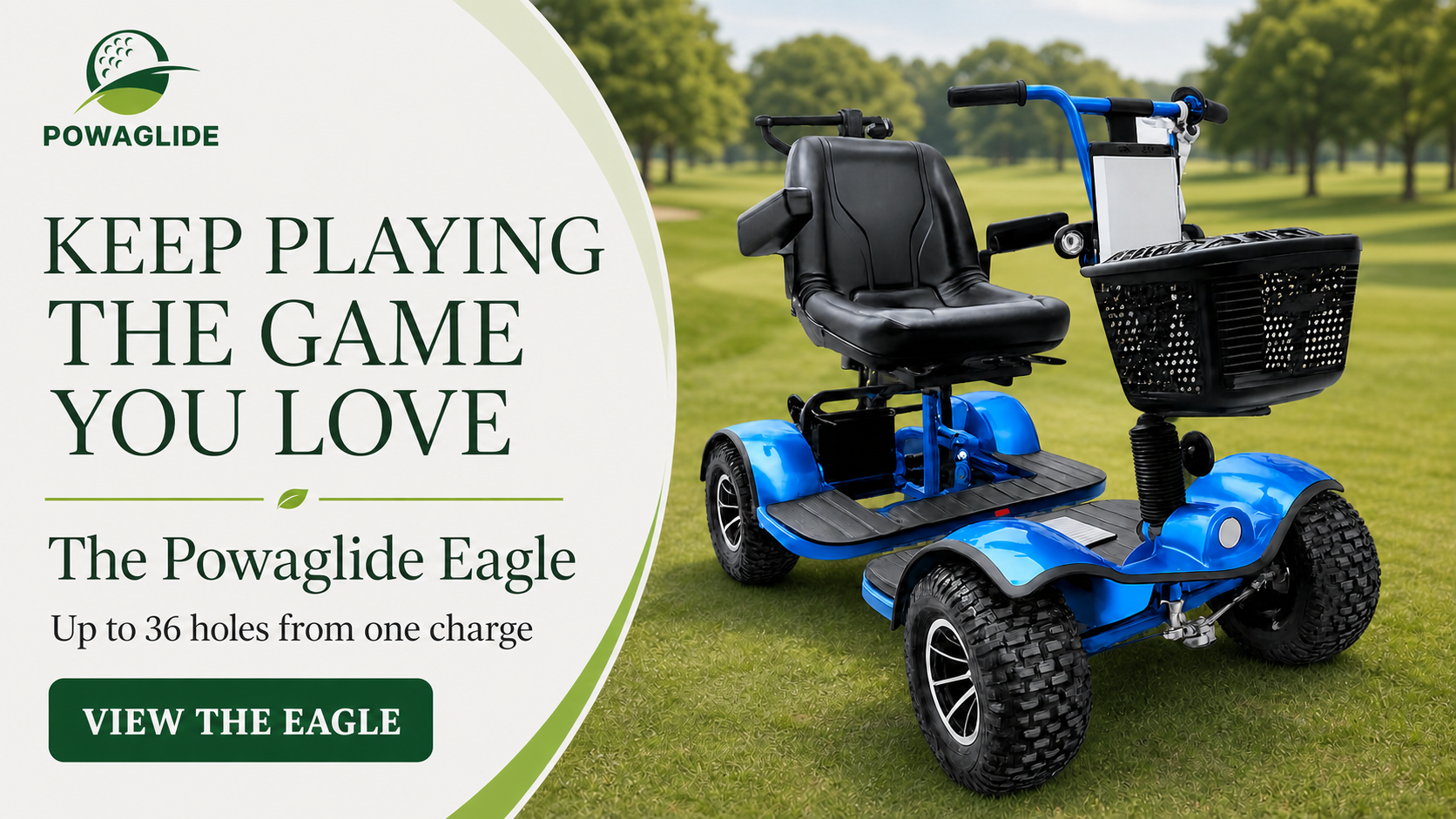
The current Powaglide Eagle single-seat golf buggy has a 50Ah lithium battery with a stated range of up to 36 holes, depending on terrain, conditions and load. Its 1000W motor, wide tyres, twisting chassis and electromagnetic braking are designed for varied golf-course terrain.
It dismantles into three main sections for transport. The heaviest rear section is approximately 45kg, so check what you can lift safely. Loading ramps may be a more sensible option than trying to lift it into the car. You can also use our guide to check whether a single-seat golf buggy will fit in your car.
Our view
Struggling to walk 18 holes is not a reason to step away from a game you still enjoy. We think the best approach is to identify the part of the round that is stopping you, then make the smallest change that gives you confidence to play again.
That might mean nine holes, a flatter course or a trolley. If walking between shots remains the problem, a personal buggy can preserve your independence and leave more energy for the golf itself. You can still walk short sections when you feel comfortable without making several miles on foot the price of taking part.
If you would like to see whether the Eagle suits your usual course, car and mobility needs, view the current specification or call us on 07787 533333 to discuss it or arrange a test drive.