Golf With Arthritis: How to Keep Playing
You have booked a round, but your knees feel stiff, your hands are sore or the thought of walking every fairway is putting you off. Golf with arthritis can take more planning, especially when your symptoms change from one day to the next. In this guide, we will look at practical ways to make the course more manageable without pretending there is one solution for every golfer.
Can you keep playing golf with arthritis?
For many people, yes. Arthritis does not automatically mean giving up golf, although you may need to change how much you play, how you prepare and how you travel around the course.
The NHS guide to arthritis explains that arthritis can cause pain, swelling and stiffness in one or more joints. It also recommends regular low-impact activity, while making clear that treatment and advice depend on the type of arthritis and how it affects you.
Golf can still involve a lot of walking, bending and rotation, so speak to your GP, physiotherapist or other healthcare professional if you are unsure what is suitable. This article offers practical golfing information, not medical advice.
Work out which part of the round causes the problem
Arthritis affects golfers in different ways. Pain in your hands or wrists may make gripping the club uncomfortable. Stiffness in your back, hips or shoulders may restrict your turn. Knee, ankle or foot pain may make slopes and long walks harder than the swing itself.
Think about when discomfort usually starts. Is it on the practice ground, halfway through the front nine or after climbing a particular hill? Does carrying or pushing your bag cause more trouble than hitting shots?
Once you know where the strain comes from, you can make a useful change instead of simply trying to tolerate the whole round.
Prepare before you reach the first tee
Give yourself enough time to get ready without rushing from the car to the tee. A gentle warm-up may help you find out how your joints feel that day before you commit to a full swing.
Arthritis UK's exercise guidance encourages people to keep moving and offers exercises for different joints. Ask a physiotherapist or qualified golf professional to help you choose movements that suit your condition and swing.
Cold or wet weather can make a difficult day feel worse for some golfers. An extra layer, waterproof clothing and a few minutes of gentle movement may be more useful than standing still beside the first tee. If early mornings are when you feel most stiff, a later tee time could also be worth trying.
Make the round smaller before giving it up
You do not have to choose between walking 18 holes and staying at home. A shorter, more flexible round can be much easier to manage.
We would consider:
- Starting with nine holes or a few holes at a quiet time.
- Choosing a flatter course with short gaps between greens and tees.
- Playing from tees that reduce the overall distance.
- Avoiding a heavy carry bag and taking only what you need.
- Allowing time for short rests rather than hurrying to keep up.
- Checking the weather and course conditions before leaving home.
If symptoms vary, keep your plan flexible. Completing nine comfortable holes is better than forcing yourself through 18 and regretting it afterwards.
Look at your shoes, grips and equipment
Small equipment changes may reduce unnecessary effort. Supportive, well-fitting golf shoes can make walking and balance more comfortable. Larger or softer club grips may be easier to hold for some golfers with painful hands, although grip choice is personal and can affect how the club feels.
A lightweight bag, trolley or club-cleaning tool with a longer handle may also reduce carrying, squeezing and bending. A PGA professional can help with grip size and swing adjustments, while an occupational therapist can advise on protecting painful hand and wrist joints during everyday activities.
Our view is to change one thing at a time. That makes it easier to tell whether the adjustment genuinely helps.

Would a golf buggy help with arthritis?
If walking is the main barrier, a buggy can remove much of the distance between shots and give you somewhere to sit. It can also carry your clubs, waterproofs and drinks, leaving more energy for the golf itself.
A buggy does not remove every physical demand. You still need to get on and off safely, operate the controls, reach your ball and make your swing. If hand arthritis affects your grip, try the controls before buying. If lifting is difficult, check how the buggy will be loaded and unloaded rather than assuming a dismantling design solves the problem.
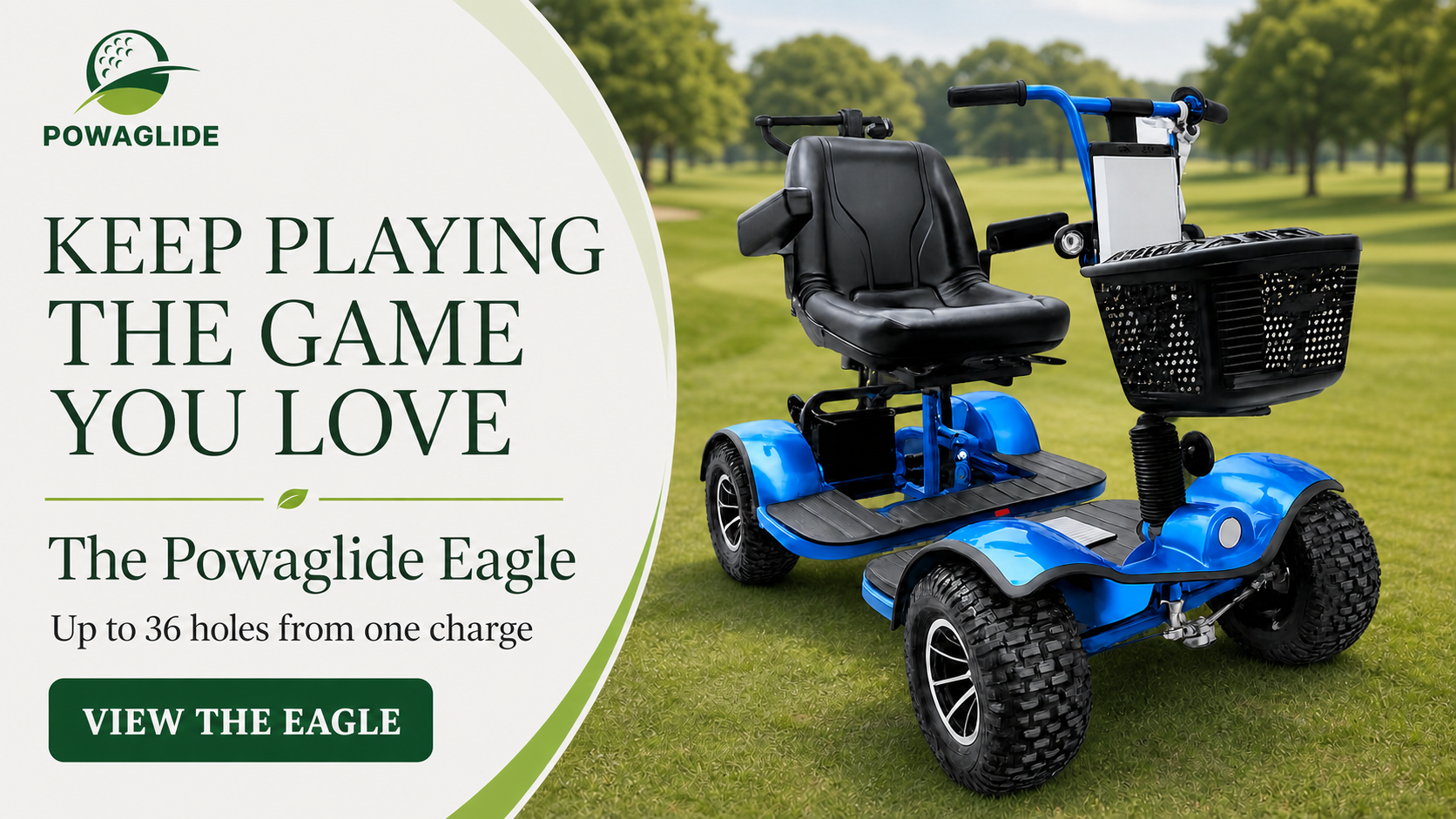
The Powaglide Eagle single-seat golf buggy has an adjustable padded seat with armrests, simple twist-grip controls and space for your golf bag. Its 50Ah lithium battery can provide power for up to 36 holes, depending on terrain, conditions and load. It separates into three main sections for transport, but the rear section weighs approximately 45kg, so loading ramps or help from another person may be sensible.
Before taking your own buggy to a course, read our guide to using a personal golf buggy at your golf club and ask the club about permission, routes and temporary restrictions.
Adjust the plan on a bad day
Arthritis symptoms can change. A plan that worked last week may be too much during a flare-up. Give yourself permission to use the practice area, play fewer holes, use a buggy or stop early.
Persistent or worsening pain, swelling or stiffness deserves proper advice. Do not use a buggy or altered swing to push through symptoms that should be assessed by a healthcare professional.
The aim is not to prove that you can complete the same round in the same way as before. It is to find a version of golf that remains comfortable, sociable and enjoyable.
If walking the course is the part that is limiting your golf, view the Powaglide Eagle or call us on 07787 533333 for straightforward advice and to arrange a test drive.