
Golf After a Knee Replacement
If you love your golf, you’ll probably start thinking about getting back on the course long before your knee is ready.
That’s completely normal. Nobody wants to spend their weekend watching everyone else tee off while their clubs sit untouched in the garage.
The good news is that plenty of people return to golf after a knee replacement. It just needs to be done sensibly and at your own pace.
For many golfers, the swing isn’t actually the hardest part. It’s walking several miles, dealing with hills and still having enough energy left to play the final few holes properly. Nobody wants a worse score because their legs have given up by the 14th!
This article contains general information rather than medical advice. Always listen to your surgeon, physiotherapist or healthcare team. They know far more about your knee than we do.
Can You Play Golf After a Knee Replacement?
Many people can and do return to golf after a knee replacement.
How quickly you get back will depend on your own recovery. It can be affected by:
Whether you had a partial or total knee replacement
How active you were before the operation
Your strength and movement
Your balance and confidence
Which knee was operated on
How well your rehabilitation is going
Whether you plan to walk or use a buggy
It’s worth remembering that a golf swing involves more than your arms. You rotate, transfer your weight and put pressure through both legs.
You might feel comfortable walking around the house but still find a full swing difficult. That’s why it’s important to ask your surgeon or physiotherapist about golf specifically.
Tell them what you’re planning to do. Hitting a few putts is very different from walking 18 holes with a full set of clubs.
When Can You Return to Golf?
There isn’t one answer that works for everybody.
Some NHS guidance suggests that certain people may be able to start returning gradually from around six weeks. Other NHS information recommends waiting closer to three months before attempting a full swing.
That doesn’t mean one answer is right and the other is wrong. It simply shows how much recovery can vary.
The NHS guidance on knee replacement recovery explains that full recovery can take several months or longer. It also recommends following the exercises and advice provided by your physiotherapist.
You’ll probably meet somebody at the golf club who claims they were back playing six weeks after their operation. Good for them, but don’t feel you need to match it.
Golf isn’t going anywhere.
Take It One Step at a Time
Your first game back probably shouldn’t be the club championship.
Start small and see how the knee responds.
You could begin with:
Putting and short chips
A few controlled half-swings
A short session at the driving range
Three or four holes at a quiet time
Nine holes using a buggy
A full round when you feel comfortable
You don’t need to follow a strict timetable. If something feels uncomfortable, stop and give it more time.
Also pay attention to how the knee feels later that evening and the following morning. You might feel fine while playing but notice that you’ve done too much once you get home.
Try the Driving Range First
The driving range is a good place to rebuild your confidence before booking a round.
Start with shorter clubs and easy swings. There’s no need to pull the driver out straight away and start trying to hit the back fence.
Think about:
Whether you can transfer your weight comfortably
How stable you feel during the swing
Whether you can finish without discomfort
How long you can stand comfortably
How your knee feels afterwards
Keep the first session short. Twenty comfortable shots are much better than forcing yourself through a full basket.
There’s always next time.

Leave the Heavy Golf Bag at Home
Even if you carried your clubs before the operation, it might not be the best idea when you first return.
A full golf bag can be surprisingly heavy. Carrying it around the course puts extra demand on your legs before you’ve even worried about hitting the ball.
Use a trolley, ask somebody to help or consider using a golf buggy.
This isn’t the time to prove how tough you are. The aim is to enjoy playing again without making the day harder than it needs to be.
Start With Nine Holes
Nine holes is a sensible first target.
It gives you enough time to test your swing, mobility and energy levels without leaving you miles away from the clubhouse if you start feeling uncomfortable.
Choose a course you already know if possible. You’ll know where the hills are, which holes have longer walks and whether there’s an easy way back after the ninth.
Playing at a quieter time can help too. You won’t feel as though you need to hurry, and there should be less waiting around between shots.
Pick the Right Course
Your first round back doesn’t have to be at the hilliest course in Yorkshire.
Look for somewhere reasonably flat, with decent paths and short distances between the greens and tees.
Before booking, think about:
How hilly the course is
Whether the paths are in good condition
How far apart the holes are
Whether you can stop after nine
Whether personal buggies are allowed
What the weather has been doing
A course that feels straightforward in summer can be a completely different challenge after several days of rain.
It’s always worth ringing the club before you travel. Ask whether buggies are allowed and whether there are any temporary restrictions.
That’s much better than turning up with all your gear and finding out the course is walking only.
How a Golf Buggy Can Help
A golf buggy removes a large amount of the walking involved in playing a round.
It doesn’t remove every physical part of golf, but it can leave you with more energy for the bit you actually enjoy.
An NHS knee replacement guide from East Sussex suggests that golfers may find it helpful to use a buggy initially before gradually building towards walking the course again.
Using a buggy can help by:
Reducing the distance you need to walk
Making hills easier to manage
Giving you somewhere to sit between shots
Removing the need to push or pull your clubs
Saving energy for the back nine
Making it easier to play nine holes at first
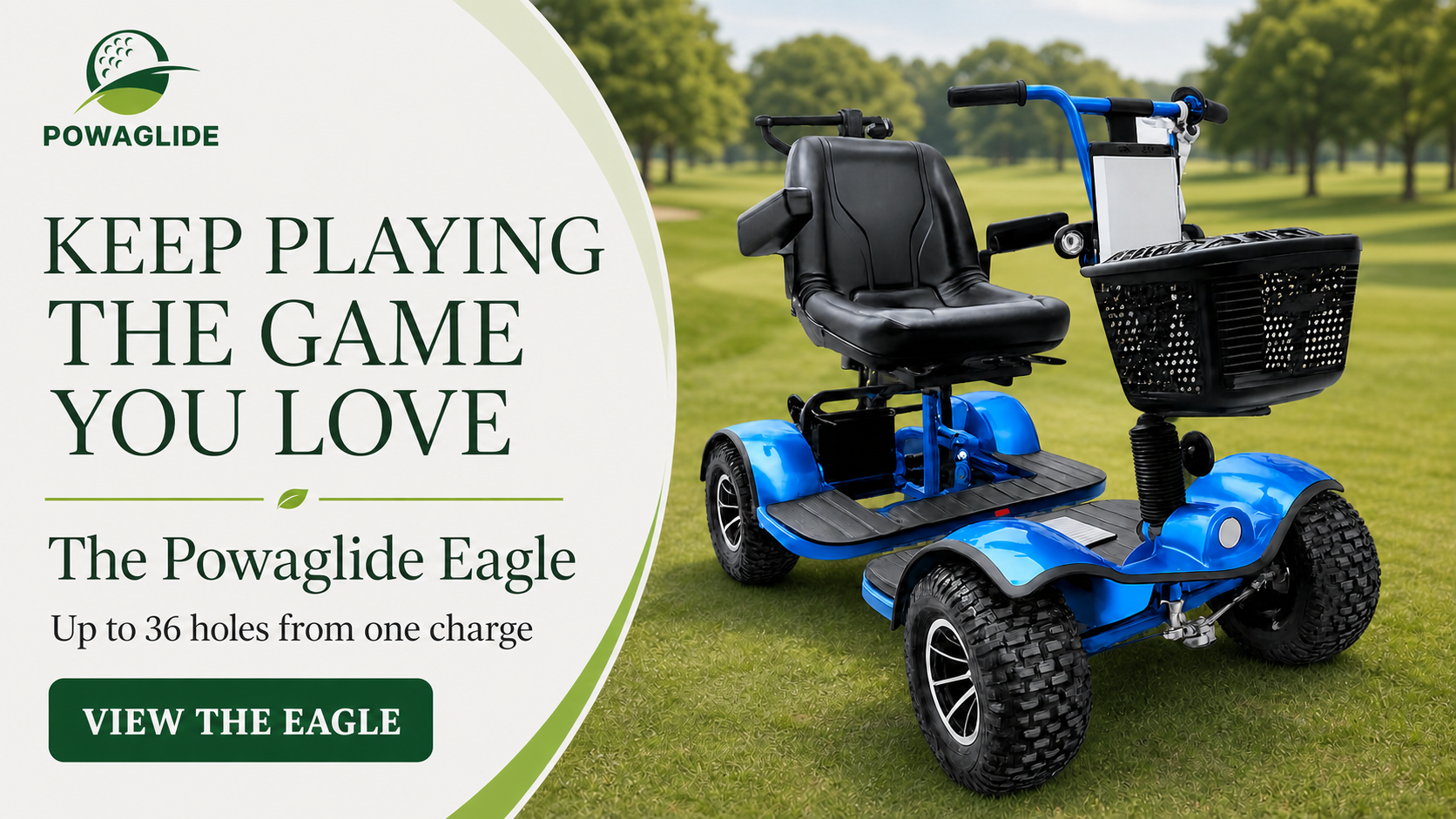
Plenty of golfers are happy hiring a club buggy. If you play regularly or travel to different courses, having your own single-seat buggy can give you more freedom.
You can travel directly to your own ball where the course rules allow, rather than sharing a buggy that keeps going from one side of the fairway to the other.
Final Thoughts
Many people return to golf after a knee replacement, but there’s no need to rush it.
Listen to your surgeon and physiotherapist, start with a little practice and try nine holes before committing to a full round.
Avoid making things harder by carrying a heavy golf bag or choosing the most demanding course you can find.
For many golfers, using a buggy is a practical part of returning to the game. It reduces the walking, gives you somewhere to sit and leaves more energy for playing.
The goal isn’t to get back as quickly as possible.
It’s to find a comfortable way to keep playing for years to come.