
How Long Does 18 Holes of Golf Take? Walking vs Using a Buggy
If you’re planning a round around work, family or the rapidly disappearing British daylight, it helps to know how long you’ll actually be on the course.
So, how long does 18 holes of golf take?
For most golfers, a sensible estimate is around four hours. You might finish considerably faster on a quiet course, while a busy Saturday fourball can easily take four and a half hours or longer.
The time isn’t determined by your handicap alone. The number of golfers in your group, the difficulty of the course, the weather and whether you’re walking or using a golf buggy can all affect the length of your round.
In this guide, we’ll explain what to expect and look at some practical ways to make 18 holes feel less tiring.
What Is the Average Time for 18 Holes of Golf?
A typical 18-hole round in the UK takes approximately four hours.
That’s a useful figure for planning your day, but it isn’t a rule. Some golfers will get round in under three hours, while others may spend more than five hours on a particularly busy or difficult course.
As a rough guide:
A solo golfer on a quiet course may finish in two and a half to three hours.
Two golfers will often take around three to three and a half hours.
A threeball may take approximately three and a half to four hours.
A fourball will commonly take around four to four and a half hours.
A busy competition round may take longer.
These times are only estimates. Even the quickest golfer cannot move faster than the groups playing ahead.
The R&A’s Rules of Golf ask players to maintain a prompt pace throughout their round. However, each golf course is different, so many clubs establish their own expected pace of play.
How Long Does Nine Holes of Golf Take?
Nine holes will usually take somewhere between one and a half and two hours.
It can be a good alternative for golfers who don’t have time for a full round or find that the second nine becomes physically uncomfortable.
Playing nine holes can also be a great way to continue enjoying golf while recovering from an injury or adjusting to changes in your mobility. There is no reason every visit to the course has to involve completing all 18.
What Affects the Length of a Round?
Two rounds on the same course can take completely different amounts of time. Here are the biggest factors.
The number of golfers
A single golfer will normally play faster than a fourball because fewer shots need to be taken on each hole.
However, group size isn’t everything. An experienced fourball that plays ready golf can move more efficiently than a pair that spends too long searching for balls or preparing for every shot.
How busy the course is
Course traffic is often the biggest cause of a slow round.
If every tee time is full, groups can begin waiting on tees and approach shots. These small delays quickly accumulate over 18 holes.
Playing early in the morning, during the week or outside peak periods may produce a much quicker round.
Course length and layout
Long courses naturally involve more travelling between shots. The distance between a green and the following tee can make a surprising difference too.
Hills, narrow fairways, deep rough, water hazards and difficult greens can all add time. Golfers generally take more shots on difficult courses and may spend longer looking for wayward balls.
Ability and experience
New golfers often take more shots, but that doesn’t mean they must be slow.
Knowing when to play, preparing while another golfer takes their shot and keeping equipment organised can matter more than handicap.
More experienced golfers can still slow a group down by taking several practice swings, reading every putt from numerous angles or waiting unnecessarily.
Weather and course conditions
Heavy rain, strong winds and soft ground can make golfers move and play more slowly.
Wet-weather restrictions may also direct players along particular buggy routes or pathways. In winter, shorter daylight hours make maintaining a sensible pace even more important.
Looking for lost balls
Under the Rules of Golf, players are normally allowed up to three minutes to search for a ball.
If several people lose balls during a round, those searches can add a considerable amount of time. Playing a provisional ball when the original may be lost outside a penalty area helps avoid walking back to replay the previous shot.

Is It Faster to Play Golf With a Buggy?
Using a golf buggy can reduce the time spent travelling around the course, although it won’t automatically produce a fast round.
If the course is busy, you’ll still need to wait for the group ahead. Buggy restrictions and designated paths can also affect where you’re allowed to drive.
The more important benefit for many golfers is energy conservation.
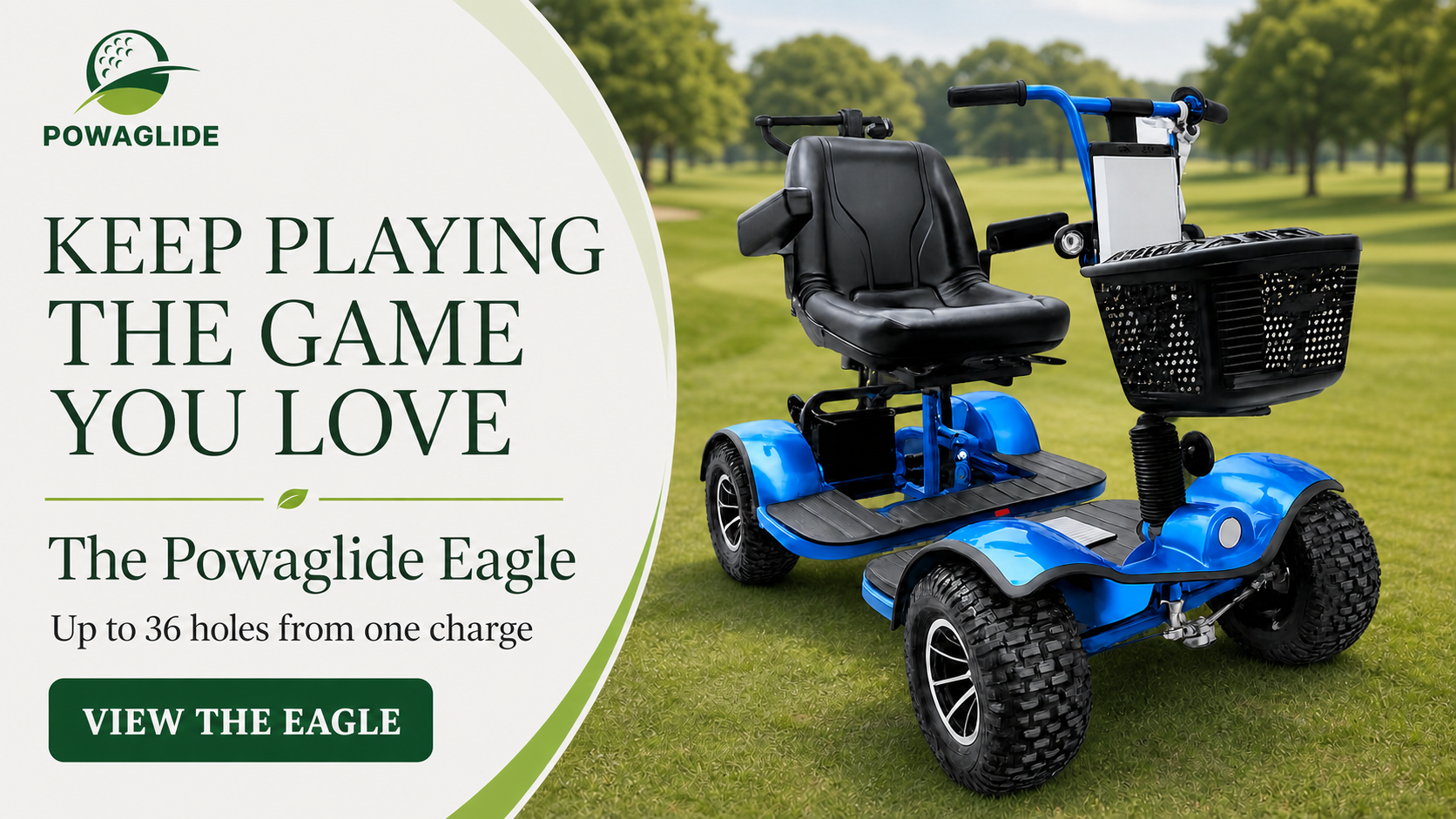
A personal golf buggy like the Powaglide Eagle removes much of the physical effort involved in walking several miles. That can help you arrive at later holes feeling fresher and more focused on your golf rather than worrying about the walk ahead.
Single-seat buggies are particularly useful because each golfer can travel directly to their own ball where course rules allow. You’re not relying on a shared two-seat buggy moving backwards and forwards between two different positions.
For golfers who struggle with walking, using a buggy can be the difference between completing 18 holes comfortably and deciding not to play at all.
When Should You Consider Using a Golf Buggy?
There isn’t a particular age or handicap at which someone should start using a buggy.
It may be worth considering one if:
Walking the course causes pain or significant fatigue.
You avoid certain courses because they are too hilly.
Your golf deteriorates badly on the closing holes because you’re tired.
You’re playing less often because of the physical demands.
You worry about keeping up with your group.
You can comfortably swing a club but struggle with the distance between shots.
You increasingly stop after nine holes despite wanting to continue.
Hiring a club buggy may be suitable if you only need one occasionally. Golfers who play regularly, visit different courses or want more independence may prefer owning a compact single-seat model.
The Powaglide Eagle electric golf buggy is designed for golfers who want to continue playing without the strain of walking the entire course. It provides up to 36 holes from one charge and dismantles into sections for transport.
If you’re unfamiliar with personal ride-on buggies, our guide to single-seat golf buggies explains how they work and what to consider before buying.
Final Thoughts
Most golfers should allow approximately four hours to play 18 holes.
Your actual time will depend on the course, group size, conditions and how busy it is. Good preparation and simple pace-of-play habits can help, but not every difficulty comes from slow golf.
For some people, the hardest part of an 18-hole round is covering the distance.
If walking is beginning to limit how often you play or how much you enjoy the closing holes, using a personal golf buggy is a practical adjustment—not an admission that your golfing days are over.
The important thing is finding a way to keep playing the game you love.